
If you lead technology, finance or operations for a company outside India, you’ve probably heard the same question in more than one leadership meeting this year: “Should we have our own team in India?”
It’s a fair question. More than 2,100 global companies already do. Most of them started exactly where you are now, with a rough headcount, a rough budget and no idea what the paperwork looks like.
This guide is written for you. It explains GCC setup in India in plain English and in the order things actually happen: the legal must-dos, the realistic timelines and the mistakes first-timers make. You don’t need to know Indian law or Indian geography to follow it.
A foreign company can own 100% of its capability centre in India without prior government approval. Most set up a wholly owned private limited company. Incorporation takes about 10 to 15 working days once your documents are ready, and 4 to 6 weeks including the bank account, the central bank filing and tax registration. The office and the first hires take longer, so plan for roughly four to six months from decision to a working team.
What is a GCC, and why are foreign companies choosing India?
A global capability centre (GCC) is an office your company owns and runs in another country to do work for the group. That work might be engineering, data, finance, customer operations or research.
It isn’t outsourcing. The people are your employees, the intellectual property stays with you, and the centre follows your processes.
India is the largest home for these centres anywhere in the world. The 2026 Zinnov-Nasscom India GCC Landscape report counts:
- 2,117 GCCs operating across 3,728 units
- 2.36 million professionals working in them
- US$98.4 billion in revenue in fiscal year 2026, up 32% since fiscal year 2021
- 506 Forbes Global 2000 companies with a centre in India
- 583 mid-market companies with one

That last number matters. A centre in India is no longer only for the Fortune 500. Karnataka, the state that includes Bengaluru, even recognises “nano GCCs” of 5 to 50 employees in its official policy.
Which setup model fits your company?
Before step one, decide how much you want to own from day one. There are three common routes.
| Model | How it works | Best for | Trade-off |
|---|---|---|---|
| Wholly owned subsidiary | You register an Indian company and hire people directly | Long-term, IP-sensitive work | Most setup effort upfront |
| Build-operate-transfer (BOT) | A partner builds and runs the centre, then transfers it to you after an agreed period | A fast start with a path to ownership | Partner fees, and the transfer terms need care |
| Employer of record (EOR) | A local provider employs a small team on your behalf | Testing India with a handful of people | Less control, and it isn’t built for scale |
The rest of this guide follows the first route. Most companies choose it, and the other two borrow many of the same steps.
The nine steps, in order
Step 1. Define what the centre will do
Write a one-page charter. List the functions you’ll move, the headcount in year one and year three, the budget, and who the centre reports to. Every later decision, from the city to the size of the office, follows from this page.
Step 2. Choose the legal entity
Most GCCs register as a private limited company that is a wholly owned subsidiary of the foreign parent. It’s a separate legal entity, it limits your liability, and it gives you full control.
India allows 100% foreign investment in IT and IT-enabled services under what it calls the automatic route. That simply means you don’t need government approval before you invest. A branch office or liaison office, by contrast, needs prior approval from the Reserve Bank of India (RBI), India’s central bank. That’s one reason few GCCs use them.
Step 3. Pick the city, then the neighbourhood
The leading hubs are Bengaluru (also called Bangalore), Hyderabad, Pune, Chennai and Gurugram. Choose on talent first, cost second and incentives third.
Bengaluru has the deepest talent pool, and Karnataka was the first Indian state to launch a dedicated GCC policy. It aims for 500 new centres and 350,000 new jobs by 2029. It also offers incentives such as rental reimbursement for centres in cities beyond Bengaluru, like Mysuru and Mangaluru.
Inside a city, the neighbourhood matters just as much. Indian commutes are long, so an office near where your engineers live will help you hire and keep them.
Step 4. Incorporate the company
Here’s what the law asks for:
- Two directors at least. One must be resident in India, meaning 182 days or more in the financial year.
- Two shareholders. Both can be foreign.
- Notarised and apostilled documents. Papers signed outside India must be notarised and apostilled in your home country if it’s part of the Hague Convention.
- An online filing. After digital signatures are issued, the name and the incorporation documents go through a single government form called SPICe+. The certificate of incorporation arrives with the company’s tax numbers (PAN and TAN).
Incorporation itself typically takes 10 to 15 working days once the documents are ready. The resident director is what trips up most foreign companies, so decide who it will be early.
Step 5. Open the bank account and bring in capital
Open a bank account in the new company’s name, and have the parent send in the share capital. The company should issue shares within 60 days of receiving the money. It must then report the investment to the RBI on Form FC-GPR within 30 days of allotting the shares. Put that date in your calendar, because a late filing slows down everything that follows.
Step 6. Complete the registrations
Before you hire, the company needs:
- Goods and Services Tax (GST) registration
- A Shops and Establishments licence from the state
- Professional tax registration
- Provident Fund (PF) and Employees’ State Insurance (ESI), India’s social security schemes, from the first hire
- An internal complaints committee under India’s workplace harassment law, which is mandatory
Step 7. Lease and fit out the office
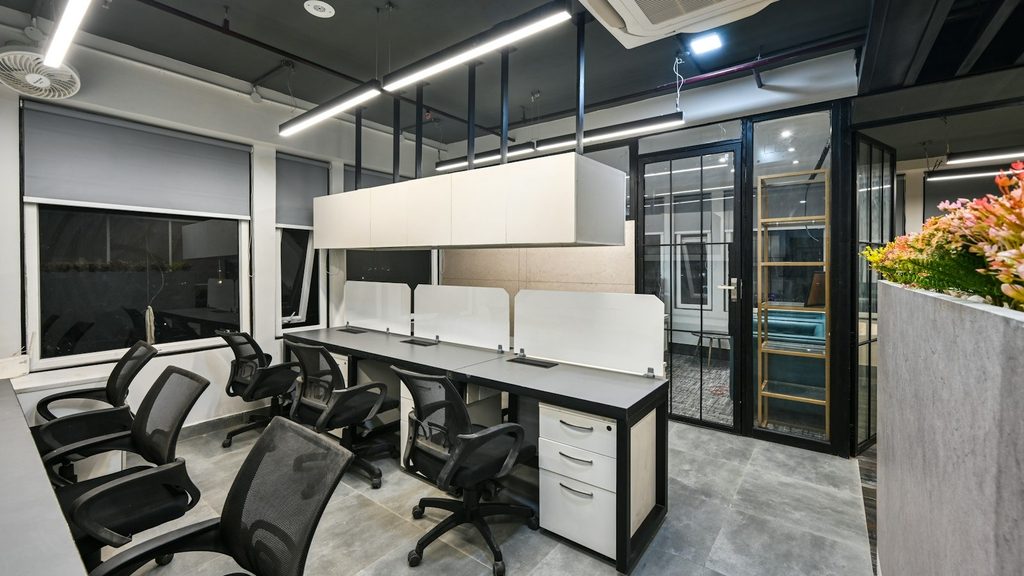
This is where timelines usually stretch, and it’s our home ground. You have two sensible routes:
- A managed office. You move into a private, ready-built space on a per-seat fee, often within weeks, on a one- to three-year commitment.
- A traditional lease in a Grade A building. Leases generally run three to nine years with a lock-in period, and the security deposit is usually 3 to 12 months of rent. You build the interiors yourself, and in return you get lower long-run costs and your own brand on the door.
Many foreign companies start in a managed office and move to their own floor once the team is settled. For reference, Grade A rents in Bengaluru range from about ₹55 to ₹250 per sq ft per month depending on the area. Our GCC advisory team can shortlist options in both formats.
Step 8. Set up the tax and intercompany framework
Your centre will usually bill the parent company for its services, so India’s transfer pricing rules apply. The price must be at arm’s length, documented and benchmarked. Sign a master service agreement between the two entities before work begins.
Ask your tax adviser about three things in particular:
- Corporate tax. The base rate is 22% for domestic companies that opt for the reduced-rate regime.
- GST on exports. Services exported to the parent can be zero-rated when the legal conditions are met.
- Permanent establishment risk. If roles and agreements are structured badly, the parent itself could become taxable in India.
Step 9. Hire your leaders, then your team
Hire the site leader first, then the first layer of managers, then the team. Set up payroll, benefits and HR policies under Indian labour law. Finally, build a compliance calendar that covers annual company filings, income tax, GST, transfer pricing and the yearly foreign-assets return to the RBI.
How long does GCC setup in India take?
| Stage | Typical time |
|---|---|
| Incorporating the company | 10 to 15 working days once documents are ready |
| Bank account, FC-GPR filing and GST | Brings the legal setup to 4 to 6 weeks in total |
| Office | A few weeks for a managed office, several months if you build your own interiors |
| Hiring | Runs in parallel, leaders first |
Put together, most first-time centres should plan for roughly four to six months from the decision to a team at their desks. Start the office search on the same day you start incorporation, so the two finish together.
What does it cost?
Costs fall into four buckets: entity setup and advisory fees, the office, technology and recruitment.
As a guide, one published 2026 cost model for a 50-person centre estimates US$10,000 to US$25,000 for entity registration, US$200,000 to US$250,000 for office infrastructure, about US$100,000 for technology and US$60,000 to US$80,000 for recruitment. It puts the first-year total near US$754,000 in India, against US$1.86 million for the same team in the United States.
Your numbers will depend on the city, the seniority of the team and the kind of office you choose. Ask every adviser for a line-by-line estimate, not a single figure.
Five mistakes first-time companies make
- Treating the office as the last step. Good buildings take time to secure. Search while you incorporate.
- Leaving the resident director to the final week. Without one, you can’t file.
- Missing the 30-day FC-GPR deadline. It’s easy to overlook when the finance team sits abroad.
- Copying a transfer pricing policy from another country. India expects its own documentation and benchmarking.
- Signing a long lease for year-one headcount. Keep room to grow, or keep the freedom to move.
How Login Realty helps foreign companies

Login Realty supports global companies through GCC setup in India from the first city shortlist to the day your team moves in, so you aren’t coordinating ten vendors across time zones. We help you:
- Choose the right city and micro-market for your talent and budget
- Lease the right office on the right terms, with zero brokerage on office leasing
- Coordinate fit-out, compliance and handover
- Arrange support for entity registration, statutory filings and your first wave of hiring
- Manage the space day to day once your team is on the ground
We’ve spent more than 30 years in Indian commercial real estate, worked with over 700 clients and leased more than 10 million sq ft. The companies we help enter India come from the United States, the United Kingdom, Japan, Singapore, Germany, France, Australia, Canada and several other countries.


